With “Final Fantasy Resonance,” Square Enix helps bridge the wait for the finale of the Final Fantasy VII remake trilogy by offering a classic-style RPG.
In “Final Fantasy Resonance,” Square Enix transports us into a pixelated world based on the iconic JRPG franchise. The title brings together a host of beloved characters from across the series into a single, classic-style RPG featuring a pixel-art aesthetic. It also includes staples like Moogles, Espers, crystals, and other familiar elements. Players looking to experience everything *Resonance* has to offer can expect a journey lasting well over 55 hours—a perfect way to make the wait for the conclusion of the *Final Fantasy VII* remake trilogy a little more enjoyable. We’ve had the chance to check out the game, and in this review, we share our thoughts.
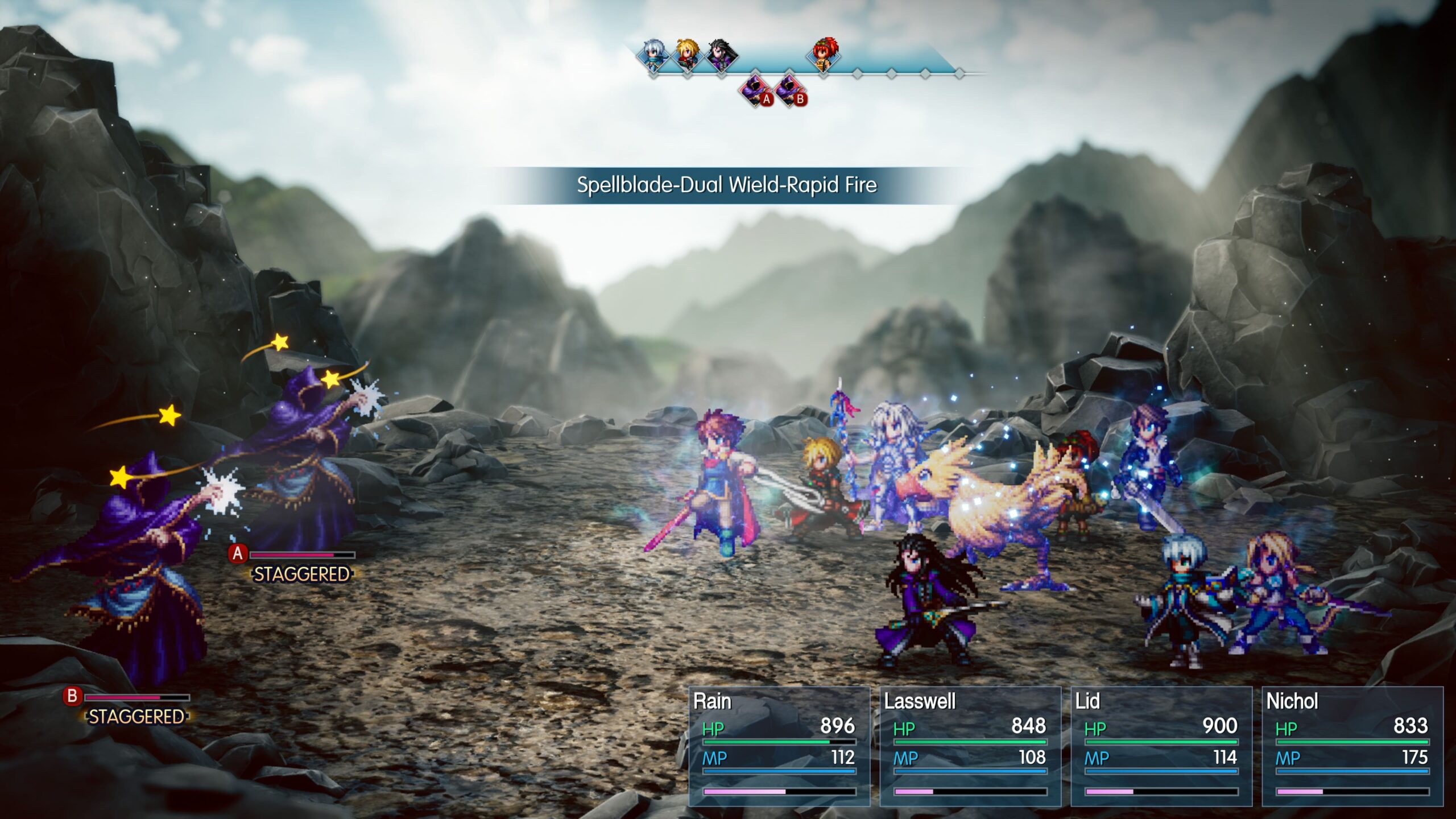
In “Final Fantasy Resonance,” our protagonist is Rain, a commander in the airship fleet of the Kingdom of Grandshelt. Together with his childhood friend Lasswell, he investigates an anomaly that leads them to a shrine—the resting place of the Earth Crystal, a powerful artifact. Upon discovering the crystal, however, they witness its destruction at the hands of a group of formidable knights known as “The Sworn Six.” The Earth Crystal is not their only target; they seek to seize the power of all the crystals.
Realizing this, Rain and Lasswell resolve to stand against the group. But the knights prove far stronger than anticipated, leaving the pair with no chance of victory. Just as they are on the verge of total defeat, a mysterious girl appears to come to their aid. While she can remember that her name is Fina, she otherwise appears to be suffering from amnesia. Nevertheless, she is determined to join the pair on their adventure to protect the crystals—and so, the journey begins.
If you haven’t had any prior experience with the series, rest assured: you don’t need to have played any previous *Final Fantasy* titles to get the hang of *Resonance*. That said, since many familiar characters and elements make an appearance, having some background knowledge is certainly recommended.
Connecting with “Visions”
In many franchises, the arrival of a well-known character is often built up beforehand—ideally, as a surprise. In *Resonance*, things work a bit differently. Here, the appearance of familiar characters is an integral part of the experience; as early as the first mission, we encounter what are known as “Visions.” These are discovered at various shrines, each introducing a new Vision. This is presented through screenshots taken from the original games in which the character first appeared. A voiceover provides context and asks what you would have done in that character’s situation—your response can even influence certain details within the Vision. Do be careful, however, if you still intend to play other games in the franchise, as these scenes occasionally contain story spoilers.
These manifestations from other worlds can be equipped by individual characters and summoned during battle to fight alongside them. Afterward, you earn “Mastery Points,” which increase the Mastery Rank between the character and the Vision. A higher rank unlocks more permanent abilities and passive buffs that can be equipped. It is definitely worth sticking with a particular Vision for the long haul.
Radical Shock
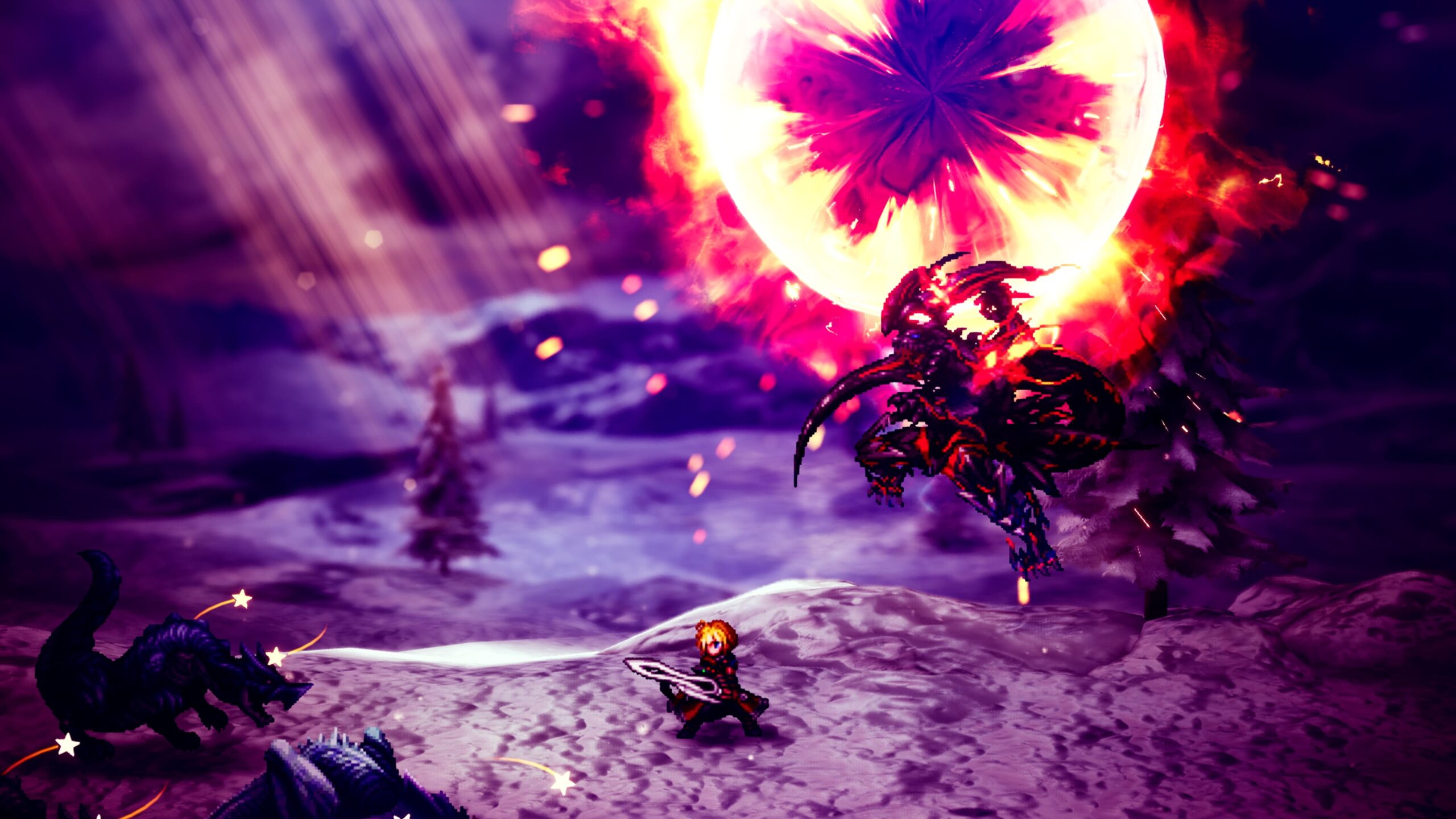
The turn-based combat follows a pattern typical for the franchise. Enemies don’t just have a health bar that needs to be depleted; they also have a “shock” gauge. Filling this gauge puts the enemy into a “shocked” state, rendering them unable to act for the remainder of the round and granting the attacking character an additional strike. It is particularly effective to manage to shock all enemies in a single round; this triggers a “Radical Shock,” granting your entire party an extra turn and allowing a selected “Vision” to unleash a special attack—accompanied by a spectacular, dedicated animation.
One thing that immediately stands out, however, is the inconsistent art style. The design of the game’s characters appears intentionally distinct from that of the Visions. This was occasionally jarring, as the transition from a pixel-art aesthetic to the appearance of realistically rendered figures on screen felt somewhat disjointed. Of course, this is a matter of personal taste, but we didn’t find the visual style to be particularly cohesive.
Visually very appealing
There is nothing to fault regarding the graphical presentation of “Final Fantasy Resonance.” The HD-2D style is a delight to behold and comparable to other games in the genre, such as *Octopath Traveler*—also from Square Enix—giving it a distinctly modern and timeless feel. The spell effects, in particular, are staged in a spectacular fashion, and the attractive character models stand out clearly against environments that frequently play with perspective and depth of field. Overall, the game offers a diverse range of settings, each distinct from the next and visually pleasing.
Another positive aspect is that, even in the later stages of the game, there is no need for tedious grinding to level up. While it may become necessary—especially later on—to complete the occasional side quest or explore the world a bit, the overall progression remains engaging and motivating. Furthermore, there are specific tasks tied to your party members; completing these unlocks permanent bonuses for them.
Chocobo!
In keeping with typical role-playing game conventions, “Final Fantasy Resonance” has us visiting various shops in a new town to hunt for fresh equipment for our party members. Beyond that, we should also keep a sharp eye out for “Maginite”—available in various strengths—which can be used to unlock new abilities for our “Visions.”
Naturally, the game also features familiar elements from other *Final Fantasy* titles. This includes the ever-popular Chocobos, which we can ride to traverse the world map, as well as encounters with iconic monsters like Cactuars or Malboros.
Conclusion
“Overall, *Final Fantasy Resonance* is a fun and engaging role-playing experience—one that truly shines if you are already familiar with the franchise. That said, even those without prior knowledge can enjoy an equally epic journey. The main drawback is perhaps the story, which follows typical JRPG tropes and sticks closely to established conventions—take the ‘amnesia’ trope, for instance. Nevertheless, the adventure is presented with great variety and is visually very appealing. The gameplay is also well-designed, with little to no need for tedious grinding. Fans of RPGs and/or the *Final Fantasy* series will certainly get their money’s worth. I highly recommend it!“
- Story/Atmosphere: 80/100
- Game Design: 90/100
- Balance: 80/100
- Scope: 90/100
- Presentation: 90/100
The review key was kindly provided to us by the publisher.